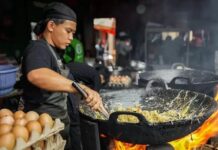
The main benefit of cooking rice with the lemang method is actually not so much because the rice is tastier, but the result (rice) can last for a longer time. The rice will not stale easily, you do not need a new container to store it because the bamboo itself has become a natural flask (thermos) , and can still be warmed, by simply putting the natural thermos directly on the coals. Therefore, the bamboo-style rice cooking method was very suitable for long trips in the past.
HISTORY
MALAYSIA
History-wise, in the book “The Cambridge World History of Food”, it is mentioned that only one region in the world, that has ever been recorded, practices the method of cooking rice in bamboo. In this book, this method is found in Malaysia where rice is mixed with meat in bamboo that is burned over a fire.
Allegedly, one of the earliest references to this writing was a book entitled “Monographs on Malay Subjects” volume 3 which was first published in 1925 and rewritten based on a monograph of which material was collected between 1864-1867 by L.A. Mills. In this monograph it is stated that someone gave rice in a container to someone else: “rice in a pot and condiments in a bamboo”. Just that one phrase.

In conclusion, the records contained in the Cambridge book and the book Monographs on Malay Subjects are proof that in Malaysia this bamboo cooking method has existed since 1864.
SUMATERA
Today’s Malaysian population is basically a mixed population or a melting pot. There are locals and there are immigrants. There are Melajoe, Madoera, Javanese, Boegis, Bandjars, Chinese, Indians, Minangkabaoese, and of course there are Bataks.
However, it is believed that way before the monograph material was collected (1864) there were migrants from Sumatera island to the peninsula Malaysia. Minangkabau and Batak migrants spread from alam Minangkabaoe and tanah Batak through different routes and then gathered in peninsular Malaysia. These two ethnic groups in their development turned into two immigrant populations, namely Selangor (Mandheling and Ankola groups) and Negeri Sembilan (Minangkabaoe group).